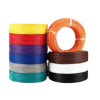
Bunched Copper Litz Wire
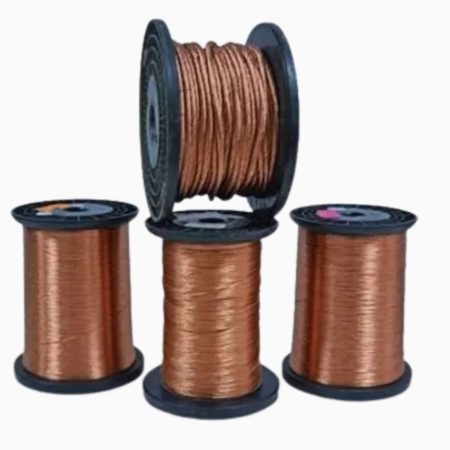
Bunched Copper Litz Wire
- Full Length 100mtr
- 600/1100 Volt
- Unsheathed PVC Insulated Cables
- All Colours ( Red, Blue, Black, yellow, Green)
Bunched Copper Litz wire consists of multiple thin, individually insulated copper strands twisted or braided together. This specific configuration minimizes skin effect and proximity effect losses in high-frequency applications.
High-frequency electrical engineering requires components that can handle rapid electromagnetic shifts without significant energy loss. best Bunched Copper Litz wire in Ghaziabad is the industry standard for meeting these demands, specifically engineered to combat the skin effect and proximity effect.
The Science of “Bunching”
In standard solid conductors, high-frequency alternating current (AC) tends to flow only on the outside of the wire (the “skin”). This reduces the effective cross-sectional area, leading to increased resistance and heat.
Bunched Litz wire solves this by using multiple strands of thin, individually insulated copper wire. These strands are twisted or “bunched” in a specific pattern so that each strand eventually occupies every possible position in the cable’s cross-section. This ensures that the current is distributed uniformly across all strands, significantly lowering high-frequency resistance (RAC).
Key Benefits for Modern Applications
Thermal Management: By reducing I2R losses, bunched wire runs much cooler than solid wire, extending the lifespan of the surrounding insulation and components.
Space Efficiency: Higher efficiency allows for smaller, more compact transformer and inductor designs, which is critical for EV charging and portable electronics.
Mechanical Flexibility: The multi-strand nature makes the wire much easier to wind around tight bobbins compared to a thick, rigid solid conductor.
Common Use Cases
You will typically find bunched copper Litz wire in:
Induction heating units.
Wireless power transfer (WPT) systems.
High-frequency power transformers and switch-mode power supplies (SMPS).
Would you like me to provide a technical table comparing different strand gauges (AWG) against their recommended operating frequencies?